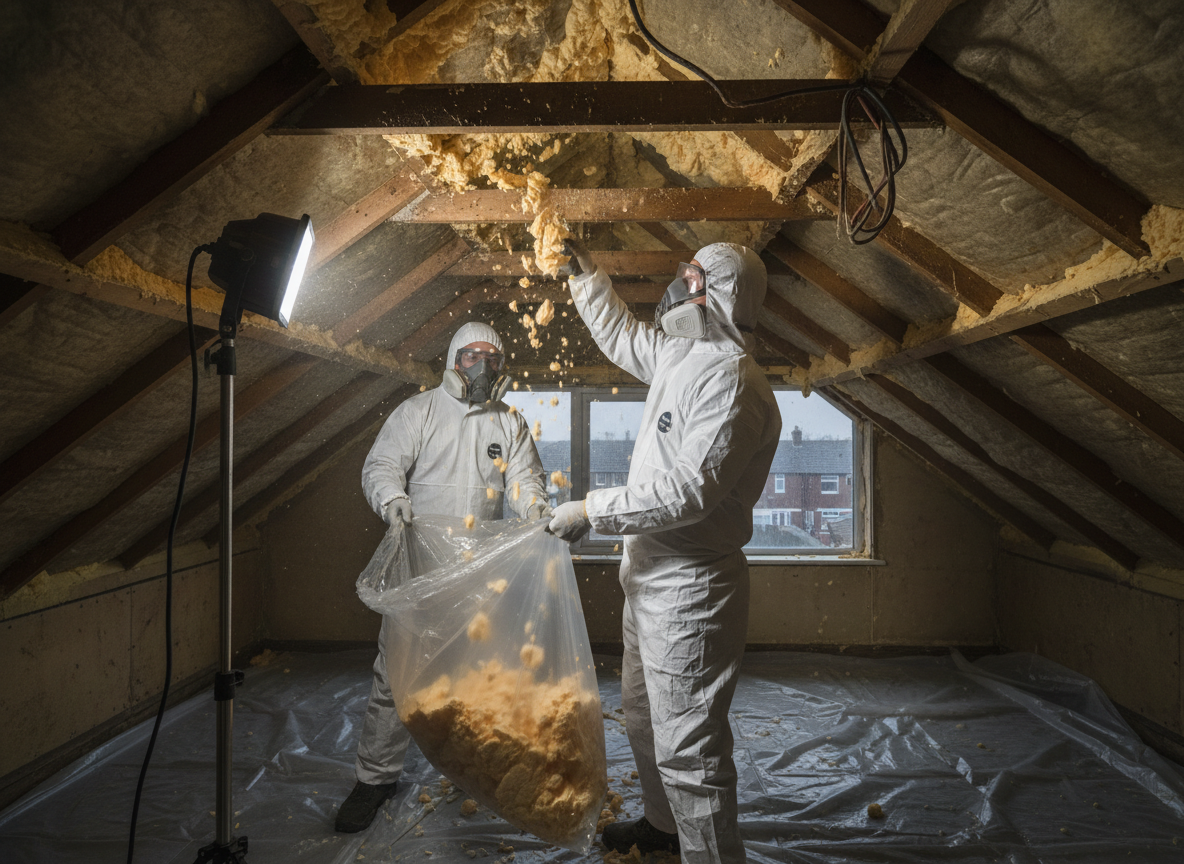
Closed cell spray foam bonds aggressively to timber joists and brickwork common in Scunthorpe’s Victorian terraces and 1930s semis around Crosby and Ashby. Removal demands mechanical cutting followed by solvent softening because the rigid structure resists simple scraping and can pull away underlying plaster or felt if forced. Winter damp in the Humber region often leaves residual moisture trapped behind the foam, so we ventilate and dry the space before any new insulation goes in.
Access routes in Scunthorpe properties frequently run through narrow loft hatches or shared chimney stacks, increasing the risk of dust migration into living areas below. We isolate each room with negative-pressure tents and HEPA filtration to keep the fine particles from settling on original floorboards or cornices still found in many DN15 homes. Disposal follows Environment Agency rules for mixed construction waste, with loads taken to the licensed site at Winterton rather than general landfill.
Homeowners sometimes attempt DIY removal using basic tools and end up damaging roof timbers or leaving thin foam layers that later cause condensation. Professional crews test substrate adhesion first and adjust technique per building age—pre-1919 solid-wall houses need gentler methods than post-war cavity constructions around Scunthorpe town centre.
Technician insight
In Scunthorpe, the thing that catches most people out with closed cell spray foam removal is how tightly it bonds to the original rafters in pre-1919 terraces around the High Street and Frodingham Road. The cold, damp winters here leave hidden moisture behind the foam, so rushing the job without proper drying leads to rot that only shows months later.
Loft Removal in Ashby Semi
Homeowner in a 1930s semi near Ashby reported musty smells after closed cell foam was added five years earlier. We found saturated timber where foam had trapped roof leaks. Careful section-by-section removal preserved the original joists, followed by drying and new breathable insulation. The loft is now ventilated and dry.
How it works
- 1
Initial Inspection
We examine the foam thickness, substrate condition and access points in the Scunthorpe property before quoting.
- 2
Containment Setup
Dust barriers and extraction equipment are installed to protect living spaces below the work area.
- 3
Foam Extraction
Closed cell material is cut, softened and removed in sections without damaging original timbers or brickwork.
- 4
Site Clearance
All waste is bagged and taken to the licensed Winterton facility; surfaces are cleaned and dried.
Pricing
Upfront quotes after inspection; cost varies with foam depth, access difficulty and property age.